
Frontex' European blackmail over migrants’ ‘voluntary’ returns
by Luca Rondi, journalist at Altreconomia. Translation from Italian by Elena Milani. Editing by Emilija Krivosic. Originally published in Italian on 1 May 2025.
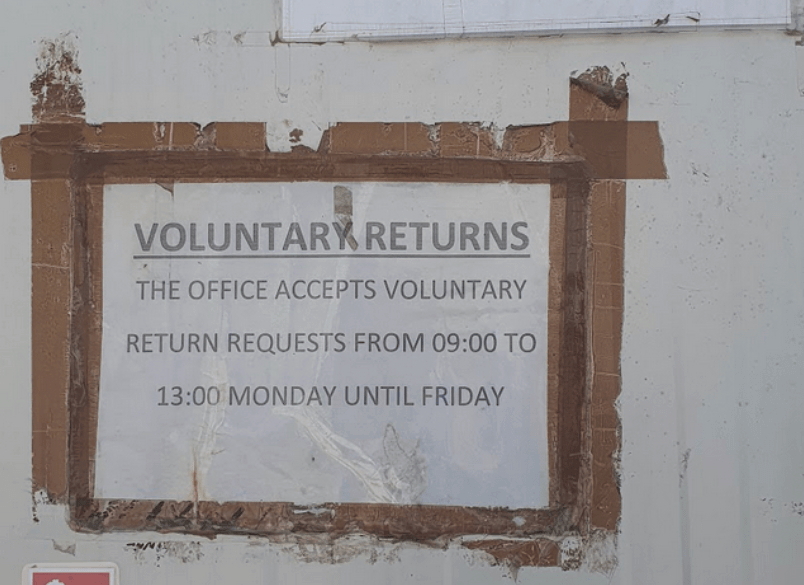
Header image: A sign inside Pournara, Cyprus’ main refugee reception centre, advertising voluntary returns to its residents, who are overwhelmingly Syrians. Credit: The New Arab
This piece was co-published with Statewatch.
“I walk the streets and I feel ashamed. Everyone knows I didn't make it and that I couldn't even pay back the money needed to pay for my trip to Europe.” Nuha sighs as he describes a difficult daily life in Sukuta, a Gambian town about twenty kilometers from the capital, Banjul. “I don't have a stable job, and even though many years have passed, I often think back to the day I was repatriated,” he says. “I hadn't committed any crime: only once did I not pay for a bus ticket, but I returned to my country with handcuffs on my wrists.”
It was November 2019, and after five years of living between Italy and Germany, Nuha was returned on a flight operated by Frontex, the EU Border Agency. Like him, over the past ten years, 1,158 other Gambian citizens have been sent back with the assistance of the European Border and Coast Guard Agency.
"They suffer greatly," emphasizes Bakary Camara, medical director of the Tanka Tanka psychiatric hospital located in Sukuta, the city where Nuha lives. "They are often admitted here for mental health problems and drug addictions developed in Europe. It's not easy to start over."
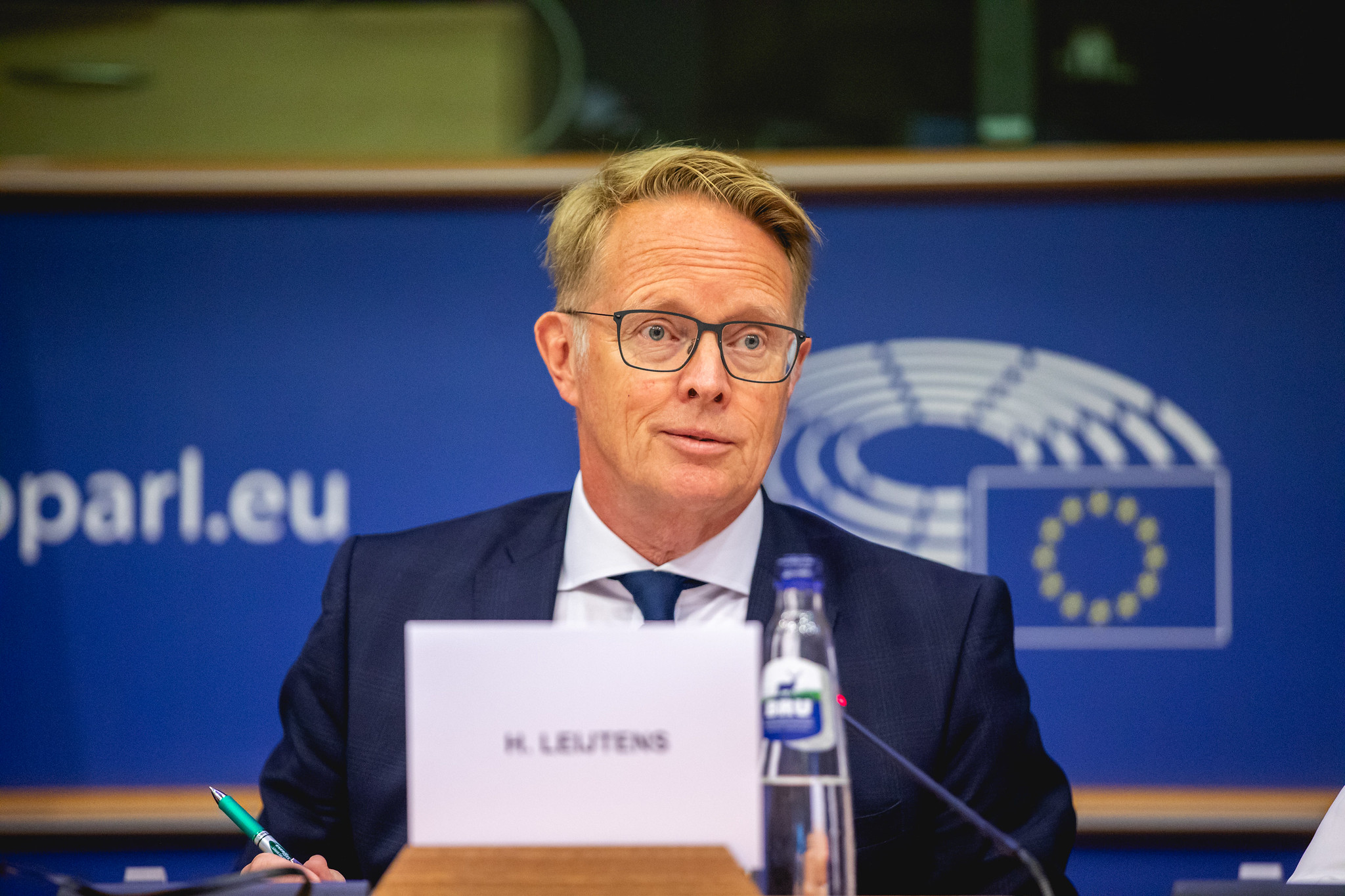
Hans Leijtens, Frontex' Executive Director. Credit: The European Parliament
Watching from Gambia, the European obsession with repatriating undocumented people appears particularly significant. Since the end of former President Yahya Jammeh's dictatorship in 2017, many young people have decided to leave one of the smallest countries in Africa, with 2.5 million inhabitants in just over 11,000 square kilometers.
The increase in emigration has had a decisive impact on the economy. In 2022, Gambia ranked 174th out of 191 countries according to the United Nations Human Development Index. The $513 million sent by emigrants abroad to their families in 2023 (so-called remittances) accounted for 21.9% of the country's gross domestic product. A crucial part of the economy.
This is also why President Adama Barrow was harshly criticised when he signed a repatriation agreement with the European Union in 2018. "When a person is deported, not only is the money they sent home lost," explains Yahya Sonko, a Gambian activist who has lived in Germany since 2015, "but also the development of local businesses. From Europe, I provide jobs for 15 people in my hometown."
The protests forced Barrow to step back and opened a standoff with the European institutions which, on several occasions, most recently in July 2024, threatened tighter visa restrictions as punishment for the country’s lack of cooperation on returns.
"This is unacceptable blackmail and a waste of money for Europeans," Sonko observes. "Sending someone back costs a lot, and that doesn't mean they won't leave again once they return. It's a harmful and useless policy." A strategy which, in numerical terms, has failed.
Let's take the third quarter of 2024 as an example. Out of a total of 112,055 people who received a so-called expulsion order” in the EU, only 28,630 were actually repatriated. This equates to one in five. “A percentage that is far too low,” underlined European Commission President Ursula von der Leyen as she presented, in early March, the new Common European System for Returns, which introduces faster procedures and has one undisputed central actor: Frontex.
"I remember well the officers who accompanied us on the plane," Nuha continues. They are from Frontex, the agency now led by Hans Leijtens from the Netherlands. In 2025, Frontex marked its twentieth anniversary and has been allocated a staggering €1.1-billion budget by the European Commission, a budget unmatched by any comparable institution. It is forty-two times larger than that of the European Cybersecurity Agency and ten times larger than that of the European Environment Agency. Of this significant amount, only €2.5 million is devoted to human-rights-related activities, while as much as €133 million goes to returns, a 42% increase compared to 2024.
“In the new Regulation proposed by the Commission,” explains Silvia Carta, advocacy officer at the Platform for International Cooperation on Undocumented Migrants (PICUM), “the central role of the Agency clearly emerges, and a further increase in funding for return operations is foreseen.”
Frontex's activity in this sector is nothing new. Since its inception, it has collaborated with Member States, supporting them by covering flight costs and pre-departure activities. However, it has carved out an increasingly important role with the new 2019 regulation. Thanks to greater opportunities to operate in non-EU countries, through officers deployed throughout the country, it has become a key player in the sensitive task of cooperating with local authorities.
The main problems with the low numbers of returns from Europe, in fact, in addition to the stratospheric costs (at least four thousand euros per person, just for the chartering of the plane, for the expulsion of a citizen from Italy to “nearby” Tunisia) are precisely the agreements with the countries of origin. As seen in the case of Gambia, these countries are often reluctant to accept such agreements.
In order to address this problem, the Warsaw-based agency and European institutions are increasingly turning to so-called voluntary returns for two main reasons: they do not require the involvement of the countries of origin because the person cooperates, and the journey is cheaper because it takes place on a scheduled flight. Today, more than half of the people leaving Europe do so "voluntarily," with Frontex increasingly leading this initiative.
Since 2019, Frontex has also assisted EU countries with voluntary repatriations, and data shows that its activity has significantly expanded since then. In 2019, the agency collaborated with nine member states to repatriate 155 people. By 2024, this had increased to 35,637 people from 26 EU member states, a 2,181% increase. Furthermore, the number of destination countries involved has also grown significantly, now numbering 117 countries compared to 41 countries six years ago. Frontex currently supports voluntary repatriations to 74% of countries outside the EU. In Africa, only Eswatini and Malawi are missing from the list.
“Brussels' strategy on this type of repatriation is ambiguous. The new Regulation provides for an embrace of voluntary returns but leaves national authorities with the option of implementing incentives for people who 'cooperate' with their own deportation by agreeing to participate in assisted repatriation programs," Carta from Picum continues. “A form of blackmail that stems from the shortening of the re-entry ban into European territory and from the financial support offered.“
For Frontex, this assistance is provided under a so-called Reintegration Programme. The short-term support provides €615 for voluntary repatriations and €205 for forced repatriations, while the long-term support provides indirect assistance for one year ranging from healthcare coverage to support in starting a business, and a total €2,000 or €1,000 incentive depending on whether the main applicant's return is voluntary or forced, with an additional €1,000 for each family member.
This endowment is managed by six NGOs selected through a public tender to operate in 38 different countries around the world. The NGOs include: Caritas International Belgium, Women Empowerment, Literacy and Development Organization (WELDO), IRARA, European Technology and Training Centre (ETTC), Life Makers Foundation Egypt, and Micado Migration. While 867 repatriated citizens were supported under this project in 2022, the number increased by 1,362% (12,676) in 2024. The main nationalities are from Turkey (2,750), Iraq (2,469), Georgia (1,472), Gambia (1,162), Nigeria (816), Pakistan (794), and Bangladesh (620).
"These forms of assistance are often ineffective for those returning to their home countries because the use of the funds is highly problematic," explains Rossella Marino, a professor at Ghent University in Belgium who completed a PhD specifically on reintegration projects in Gambia. “They are extremely useful, however, to the European institutions, because they frame, through a positive and acceptable narrative, namely that of helping people who return, what is in fact a neo-colonial approach ultimately aimed at controlling mobility.” Marino emphasizes how the repatriation ‘machine’ involves numerous actors on the ground. "All these activities consolidate the presence of European institutions in that territory, but above all, they help prevent returnees from leaving. This process also occurs through the digitalisation of all information."
The digital platform Reintegration Assistance Tool (RIAT) was developed precisely for this purpose, funded by the European Commission and implemented by the International Centre for Migration Policy Development (ICMPD). Through this platform, cases accessing the Frontex programme are constantly monitored and cooperation between Member States is improved.
There's also an issue of responsibility regarding Frontex's role in repatriations. The issue fundamentally concerns whether Frontex holds responsibility for any events that take place prior to repatriation. What happens, for example, if the expulsion order underlying the person's repatriation is unlawful? Who is responsible? Or what if, in the case of voluntary departure, the person was not in a position to make an informed decision? This aspect is crucial. "Frontex takes advantage of the fact that responsibility for everything that happens before repatriation falls solely on the Member State. But this isn't the case," explains Laura Salzano, lecturer of EU law at the Ramon Llull University in Barcelona who has been studying these issues for years. "The Agency must assess on a case-by-case basis whether the expulsion is lawful or not: its own Regulation, Article 80, requires it to do so."
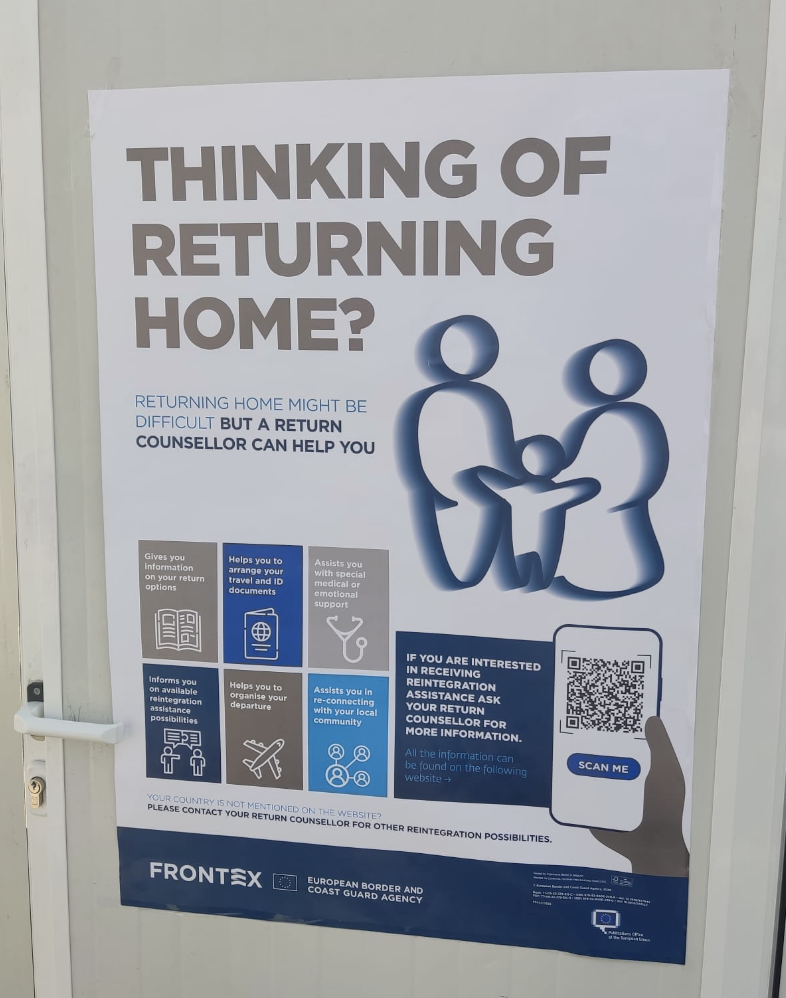
A poster on the door of Frontex’s office inside the Pournara camp in Cyprus. Credits: The New Arab
All of this also concerns Italy greatly. Our country, along with Romania, is at the bottom of the European rankings for voluntary repatriations. Over ten years (2015-2024), according to data provided by the Ministry of the Interior to Altreconomia, 4,059 people were repatriated through this program, for a total of €35.5 million invested by the Ministry of the Interior. In 2024, all 290 assisted return cases, 42% of which involved irregular migrants, were managed by the International Organisation for Migration (IOM).
In recent months, however, reports have grown from Italian repatriation centers (CPRs) reporting intense pressure from operators to access what are called "voluntary departures." An IOM official, who prefers to remain anonymous, confirms that the organisation he works for does not initiate voluntary repatriations from CPRs.
Frontex is stepping in with its Reintegration Programme, which now appears to be a priority for Italy as well. Everything is managed by the police headquarters, which monitors cases on a case-by-case basis, reporting to Warsaw those who agree to leave the country immediately. The agency's long arm has thus also reached Italian detention centers. And who knows, perhaps it will soon land in Albania as well.
"Six years later," Nuha concludes, "one of the things that hurts me most is not being able to hug my wife and daughter before leaving: they made me leave through the back of the police station, and she tried to follow the car, but they lost her. She was crying, screaming, and so was her daughter. This is the last image I have of Europe."
The Border Violence Monitoring Network accepts submissions for its blog. To contribute, please send your submission to press@borderviolence.eu
Thank you for your interest. We look forward to your contribution!