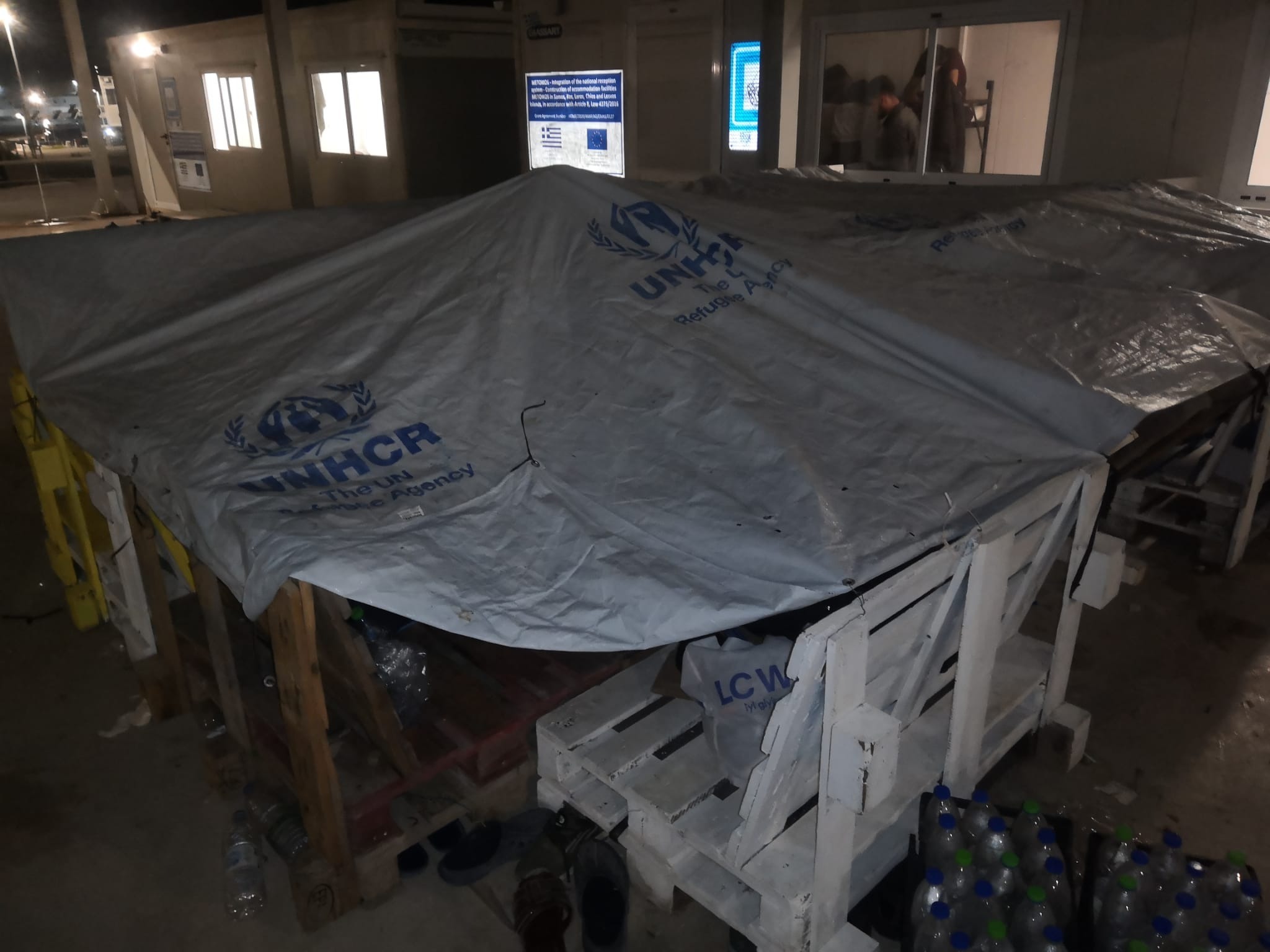
“We tried to create a shelter for ourselves from the tables and chairs that were in the square of B0 of the camp. We have wood on the floor and material over the top”.
| Between May 2023 and September 2023 | Samos Closed Controlled Access Center (CCAC) | Anonymous | 45.7908691, 15.9976521 | Detention and Reception Reports | Closed Controlled-Access Centre of Samos | Closed Control Access Centre (CCAC), Transit Reception Centre for Foreigners | no | yes | no | no | no | yes | Syria | Beating (Kicking), Pushing People to the Ground, Shouting | Lack of Protection from Weather Conditions, Poor Hygiene Conditions, Overcrowding conditions, Lack of Adequate Means of Rest, Lack of Translation, Physical Violence | 61 to 180 days |
The respondent arrived on Samos between July and December 2023, with 19 other people from Palestine and Syria. After arriving at the Samos Closed Controlled Access Centre (CCAC) the respondent was de facto detained for 17 days, “I spent 17 days in quarantine”. During this time, he was in Section B0 of the CCAC, where he was accommodated with the 14 men from his arrival group (“The three ladies and the small girl I arrived with were taken somewhere else”). The 15 men were accommodated in an empty container without beds, “we were sleeping on blankets on the floor”. The respondent reports that during these 17 days he did not have access to a shower.
The respondent explains that, after these 17 days, in the afternoon, a CCAC employee he calls “the coordinator of the CCAC” came to the container in B0. The respondent recalls that, “we were around 15 [men] at that time”. The "coordinator” told the group that they had to immediately vacate the container because another group of men were to be moved in there. The respondent reports that the other men were being moved from Section D2 to make space for police to be stationed within the CCAC, using Section D2 as their “base”. The respondent recalls that “the coordinator” told the group that they would have to find their own accommodation by themselves looking for spare space in the CCAC. The respondent reports that “the coordinator” did not come with an Arabic interpreter but that one of the 15 spoke some English so was required to interpret on her behalf. “She was shouting at us, we argued but in the end we left because we thought we would find a place to stay. We were told that new people would be in the container and we had to find our own place to live. When we left she [“the coordinator”] locked the container after us”.
It is important to note that, around that time, the Ministry of Migrations’ statistics recorded the Samos CCAC as having a population of 3,862. This puts the CCAC as either at 189% capacity or at 105% capacity, depending on which official capacity figure is used: either 2,040 (which was the official capacity until September 2023) or the 3,650 figure that was announced overnight by the Ministry in September 2023 following criticism on the CCACs over capacity. While the authorities did open Section C of the CCAC to accommodate asylum seekers (intended as a Pre-Removal Detention Centre), this section’s capacity is 900 only, leaving 710 unaccounted for. It is therefore unclear which measures were taken by the authorities to increase the official capacity of the CCAC by 178%.
The lack of capacity on that day is evidenced by the respondent's testimony who reports: “We tried to find a place for the night but we could not find space in any of the other containers to stay in. Everywhere was very overcrowded. So we [the 15] decided to go back into the container of B0, which was empty that night, otherwise we would sleep outside. A friend moved a window of the container for us to go back. He didn’t break the glass but he managed to lift the window without breaking anything, he didn’t do any damage, the window is still working. So that night all of us 15 went back in”.
The respondent reports that on that night the group of 15 men slept on the floor of the container.
On the next day, the respondent reports that “the coordinator” came to the container at around 1pm or 2pm. “She came back and was screaming at us. We were ignoring her, hoping she would go away so we could stay in the container but then she called the police”. The respondent reports that around seven “police officers” came who were wearing “the usual blue uniform”. The respondent recalls, “I was lying down, they started screaming ‘get out, get out’ they [an officer] even kicked a guy on the floor”. The respondent reports that he was trying to get his belongings when he was pushed to the floor by a police officer, “I was trying to get up to get my stuff. He shoved me with his hands on my shoulders and I fell on the floor. I could recognise the police officer that pushed me. He had blonde hair, blue eyes and he is a bit short, he is probably above 30 years old”. The respondent is not sure if this is the same officer that kicked the other man on the floor as he did not see the face of the officer who kicked the man.
The respondent continues, “so we all left the container. We were standing outside, and were allowed to go in to get our stuff one by one”.
Since that day, the respondent reports that he has been sleeping outside in Section B0. Samos has seen thunderstorms and heavy rain during this period. “We tried to create a shelter for ourselves from the tables and chairs that were in the square of B0 of the camp. We have wood on the floor and material over the top”. The respondent explains that the group gets wet when it rains. The respondent shares photos of the makeshift shelter used by the men which appears to be made of pallet benches and UNHCR tarpaulin. The respondent reports the 15 men have been required to use this as accommodation for the last 20 days.